

Tesla has taken an important step toward the future of transportation. For the first time, the self-driving Model Y was spotted on South Congress Avenue in Austin, Texas. This signals the start of what might be a revolution in driverless ride-hailing. Tesla has been covertly testing these self-driving vehicles throughout the city for weeks. Still, Tuesday’s sighting is unique: it is the first time the public has seen a Tesla vehicle operating totally on its own, with the “Robotaxi” logo openly displayed on the side. Equipped with the company’s Full Self-Driving (FSD) software, this Model Y signals that Tesla may be nearing the commercial debut of its Robotaxi platform.
The First Real-World Robotaxi Appearance
The Model Y seen in Austin wasn’t just another FSD test. It had no driver and was branded with the new “Robotaxi” logo. This audacious exhibition shows that Tesla is confident enough to bring testing to public roadways in obvious ways. The vehicle runs the most recent version of Tesla’s Full Self-Driving software and is likely part of a larger effort to normalize driverless transportation in everyday situations.
Despite the excitement, Tesla isn’t rushing to launch. AI engineer Srihari Sampathkumar posted on X:
“A tremendous amount of testing is underway to ensure a safe and slow rollout in the beginning. The future is going to be wild.”
This highlights Tesla’s intention to avoid shortcuts when it comes to public safety. The company is committed to a cautious rollout, even as it continues to lead the pack in self-driving innovation.
No Official Timeline Yet, But Clues Emerge
While Tesla has not announced a formal launch date, industry experts believe it could happen soon, possibly as early as June 12, according to an unofficial report. The appearance of the Robotaxi logo and wordmark suggests that Tesla is about to transition from testing to branded service distribution. This would represent a significant change from internal development to public-facing mobility solutions.
Behind the Wheel? Or Behind the Scenes?
Even if the Model Y was seen operating without a driver, there is still an air of mystery. Tesla has not disclosed if these vehicles are fully driverless or controlled remotely by human supervisors. A remote operator is probably monitoring the vehicle’s performance, particularly during the early trials.
This lack of transparency is not uncommon in the self-driving world. Many businesses rely on human oversight during the early phases to maintain safety. Tesla’s silence on this matter begs the question of whether this is a meaningful step toward Level 5 autonomy or a tightly monitored system. Until Tesla offers further information, the public can only conjecture on the role of human intervention, whether behind the wheel or a screen.
Elon Musk’s Vision: FSD as a Global Standard
Elon Musk has long stated that Tesla’s Full Self-Driving software will become the industry standard. With the Robotaxi’s introduction imminent, he’s making it obvious that other manufacturers may soon be forced to license FSD.
“As Tesla robotaxis become widespread and their other solutions don’t work, they will naturally turn to us,” Musk stated.
He criticizes the belief that simply buying Nvidia hardware can solve self-driving challenges. In Musk’s opinion, autonomy requires full-system integration—hardware, software, and real-world data—which Tesla has been developing for years.
Musk believes that as other companies experience delays and technical challenges, Tesla’s established system will become the default option. Licensing FSD would provide automakers with a shortcut to autonomy that avoids reinventing the wheel. This strategy presents Tesla not only as a car manufacturer but also as an industry-wide platform provider.
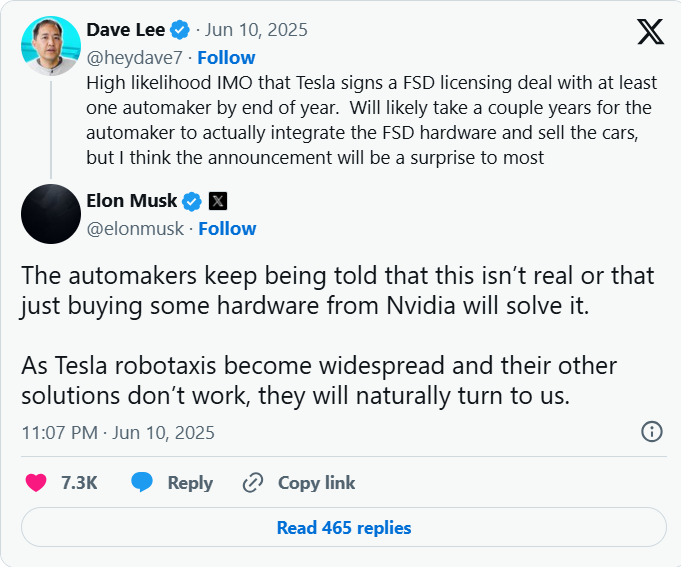
Investor and Tesla analyst Dave Lee predicts that at least one automaker will license FSD by year-end.
“It will take two years or so to solve the engineering and design applications,” he said.
This means that even if a company signs a contract today, it will not be able to deploy vehicles with Tesla’s FSD immediately. Nonetheless, such a step would establish Tesla’s software as the industry standard. Speculation goes to Ford, particularly given its previous partnership with Tesla on charging infrastructure.
All Cars Might Have to Get Smarter
Elon Musk has emphasized that cars without smart capabilities will become obsolete. He stated earlier this year:
“Once it becomes obvious that if you don’t have this (FSD) in a car, nobody wants your car… it’s a smart car.”
Tesla believes that autonomy won’t be optional in the future—it will be expected. If automakers don’t adapt, they risk being left behind. Tesla aims to lead this transformation by turning its software into a must-have feature for future vehicles.
The Human Side of Autonomous Vehicles
While Tesla’s name frequently generates excitement about self-driving technologies, public trust remains shaky. According to social media sentiment analysis, people are generally optimistic about autonomous vehicles (AVs) when Tesla is engaged. However, safety concerns—particularly with pedestrians, unanticipated events, and blind spots—continue to arise.
Recent research done by Qiyuan Zhang at Cardiff University reveals a deeper issue: when AVs are involved in an accident, public confidence drops more abruptly than with traditional automobiles. This is more than just technology; it is about accountability, liability, and the fear of losing human control.
Tesla’s Robotaxi is more than just a product; it’s a representation of what is possible. The Austin sighting verifies the company’s real-world development. With a likely launch date just days away and mounting speculation over FSD licensing, Tesla is poised to change the car industry once more.
As Elon Musk continues to defy the existing quo, one thing is clear: the race for full autonomy is on—and Tesla is gaining ground.