

Charging your Tesla at the ski resort needs to be organised from down in the valley – not once you’ve parked at the foot of the slopes with 12 per cent battery remaining. The cold, the elevation gain and overloaded charging points on a Saturday during the holidays turn what should be a simple task into a headache. Here’s the method we recommend to owners who head up to ski every winter.

Charging your Tesla at a ski resort: it all comes down to the valley
For a stress-free Tesla charge at a ski resort, the golden rule is to arrive with plenty of battery to spare. Climbing a mountain pass uses a lot of power, and a cold battery limits regenerative braking. So plan a stop at the last Supercharger before the climb: entering this Supercharger as your destination in the sat-nav starts the battery preconditioning process, which significantly speeds up the charging session. Aim for 80 to 90 per cent before setting off again, then drive up at a leisurely pace, in Chill mode if the road is covered in snow.
What to expect when you arrive
There are three possible scenarios. Some resorts have public AC charging points in their car parks, often rated at 11 or 22 kW, which are in high demand during the school holidays. Hotels and holiday apartments offer ‘destination’ charging, which must be booked at the same time as your accommodation. Finally, many covered car parks only offer a high-current socket or a CEE industrial socket – blue or red – which can be used with the operator’s permission. Ask about this over the phone before booking: this will determine the whole of your stay.
The right cable in the boot
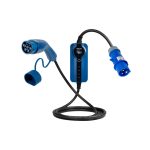
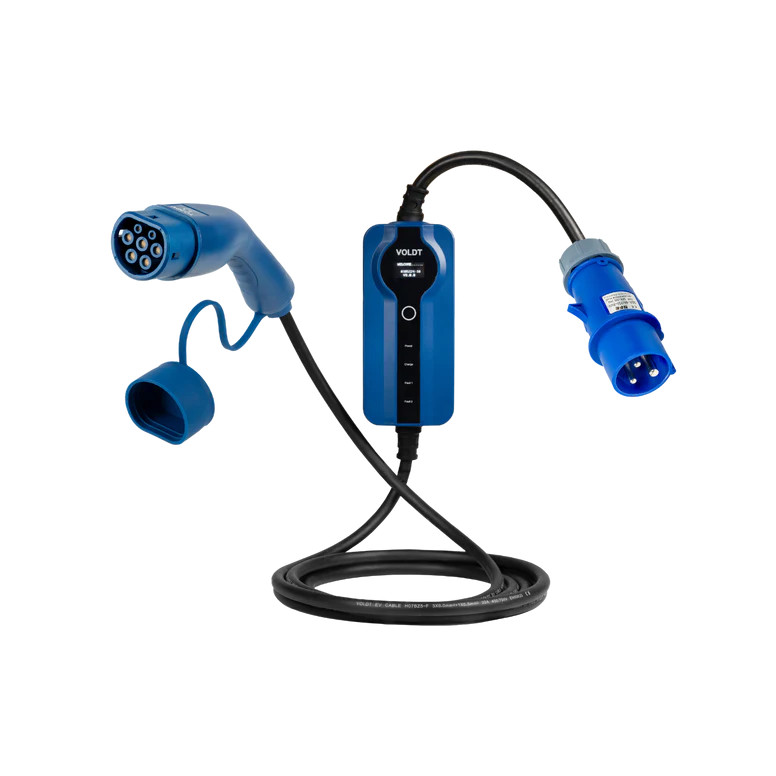
To charge your Tesla at a ski resort using a public charging point without a fixed cable, you’ll need your own Type 2 cable. The Type 2 – Type 2 – 22 kW charging cable (€114.00) works on all AC charging points; your Tesla will simply limit the power output to what its on-board charger can handle. For domestic industrial sockets, the Type 2 – CEE – 7.4 kW portable camping charger (€219.90) adds several tens of kilometres for every hour of charging. Store both in the under-boot compartment, away from slush and road salt.
Tesla charging at a ski resort: the cold changes everything
A cold battery accepts less power. If parked overnight at -10 °C, your car will charge slowly at the start of the session whilst its cells warm up. So plug in as soon as you arrive, whilst the battery is still warm from the drive up, rather than the next morning. Then set your departure time in the app: the cabin and the battery will warm up whilst plugged in, rather than whilst you’re driving. The tesla.com support page explains these settings in detail, and our winter range guide provides further information.

The pre-journey checklist
- Tesla app updated and departure time set;
- Type 2 cable or CEE portable charger in the under-bonnet storage compartment;
- Accommodation confirmed: charging point, socket, rates, covered car park;
- last Supercharger in the valley located, charge at 80–90 per cent;
- pre-conditioning initiated before each fast-charging session;
- Sentry Mode switched off for long-term parking.
Parking for a week without a charging point
No Tesla charging available at your ski resort accommodation? Don’t panic. A stationary Tesla loses very little energy if you switch off Sentry Mode and limit the number of times you check the app, as each connection wakes the car up. Keep a comfortable reserve for the week, de-icing when you set off, and the journey home. The descent into the valley, using regenerative braking, will give you a few kilometres back. For the rest of the kit, see our guide to going skiing in a Model Y.

Frequently Asked Questions
Can you plug your Tesla into a domestic socket? Yes, with theproperty manager’s permission and a suitable charger; the power output is limited, so allow for a full night’s charge.
Is charging at a Tesla ski resort chargingpoint more expensive? Often yes: resort charging points apply their own rates, which you should check in the operator’s app.
Do you need to charge to 100% before the ascent? Rarely: 80–90% is sufficient, unless you’re facing a long climb with no Supercharger in the valley.
Does the cold damage the battery when the car is stationary? No, the car protects it; the cold mainly causes a temporary reduction in range and charging speed.
Green Drive’s advice
When on a break, it all comes down to three key habits: topping up at the last Supercharger, keeping a suitable cable in the boot, and choosing accommodation that has a suitable charging point. Cables and portable chargers are available in the charging points and cables section.