





SpaceX has finally achieved a major milestone with its Starship program. The 10th test flight became the first to deploy mock satellites, proving the rocket’s potential in real-world missions. The launch proceeded at the company’s Starbase facility in Texas, capturing global interest. Unlike previous missions, which ended in explosions, this mission indicated steadiness and advancement. The Super Heavy booster separated smoothly, the upper stage released eight test satellites, and vital heat shield and reentry data were collected. SpaceX declared it a success, noting that “every major objective was met.” For space exploration enthusiasts, this voyage was a watershed moment.
A Breakthrough in Satellite Deployment
For the first time in history, Starship successfully sent eight dummy satellites into orbit. This phase is significantly more important than a simple test. Starship was designed to carry a greater load than Falcon 9, allowing it to launch more satellites in one go. This leads to faster, cheaper, and more efficient satellite networks.
The clear winner here is Starlink, SpaceX’s internet constellation. With Starship, Starlink could rapidly expand coverage to remote areas of the Earth. Students, gamers, and even entire countries with underdeveloped infrastructure may profit. Flight 10 proves that the concept of launching hundreds of satellites at once is no longer just a theory; it is now a verified ability.
Testing the Power of Reusability
Reusability is the heart of SpaceX’s vision. Elon Musk wants Starship to be fully reusable, from booster to heat shield. During Flight 10, SpaceX pushed the rocket to extreme conditions to see how it handled stress. Some heat shield tiles fell off, and part of a flap burned away during reentry. But this was intentional. SpaceX explained that the ship was flown on a punishing path to test its weakest points.
Even after this “stress test,” Starship managed to survive reentry, execute a landing flip, and achieve a soft splashdown in the Indian Ocean. Musk praised the effort, writing: “Great work by the SpaceX team!!” Reusability remains a huge challenge, but Flight 10 showed that SpaceX is making real progress toward rockets that can fly repeatedly without massive repairs.
Praise, Criticism, and the Public Narrative
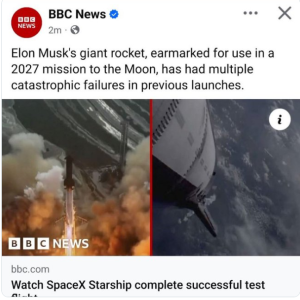
While engineers celebrated, the media had mixed reactions. Outlets like the BBC focused on the failures of past missions, mentioning Starship’s “multiple catastrophic failures.” CNN also used a negative tone, calling the rocket a “troubled prototype.” These headlines show how Musk’s companies often attract criticism, even during moments of success.
However, not all the coverage was negative. The New York Times called the test a “nearly flawless flight,” and Fox News hailed SpaceX for overcoming previous difficulties. This contrast highlights how Starship is more than just a rocket—it’s also a public story that stirs debate, divides opinion, and keeps the world watching.
Mission to Mars and Beyond
Starship is more than just a satellite launcher. Elon Musk’s gravest ambition to date is his plan to transform humans into a multi-planet species. NASA also uses a variant of Starship for its Artemis mission, which seeks to return astronauts to the Moon by 2027. Musk, on the other hand, has a more ambitious goal: colonizing Mars.
To achieve all of these goals, SpaceX must overcome significant difficulties. Orbital refueling, reusable heat shields, and quick turnaround between flights are all currently being developed. But Flight 10 shows that every step taken brings Musk’s goal closer to reality. For young space enthusiasts, this expedition demonstrates that interplanetary travel may not be science fiction forever.
Starship Stands Tall—The Most Powerful Rocket Ever Built
SpaceX’s Starship, combined with its Super Heavy booster, is the tallest and most powerful rocket ever created. It stands nearly 400 feet (about 122 meters) tall, driven by approximately 16.7 million pounds of thrust at liftoff—setting a record for power.
How Starship Compares to Historic Giants
Saturn V (NASA’s Apollo-era workhorse): Reached about 360 feet (110 meters) and produced around 7.5–7.6 million pounds of thrust. Roughly half the power of Starship.
Soviet N1 Rocket: Never succeeded in flight, but was designed to deliver over 10 million pounds of thrust—still about 40% less than Starship.
Space Shuttle (with boosters): At about 180 feet (55 meters) tall with two solid rocket boosters, it delivered approximately 5.3 million pounds of thrust at liftoff.
Falcon Heavy (current SpaceX heavy-lift): Reaches about 230 feet (70 meters) and produces around 5 million pounds of thrust—only about one-third of Starship’s lift-off thrust.
NASA’s Space Launch System (SLS): Debuted in 2022, is currently the most powerful operational rocket, generating around 8.8 million pounds of thrust—just over half of what Starship can muster. It stands around 322 feet (98 meters) tall.
What Makes Starship Unique
Reusability: Unlike Saturn V, N1, and SLS—all expendable—Starship is designed to be fully reusable, dramatically cutting costs and turnaround time.
Engine Power and Efficiency: Its first stage alone uses 33 Raptor engines, giving it more thrust than any rocket before.
Massive Payload Capacity: Starship can carry 100–150 tons to low Earth orbit, like or exceeding Saturn V, but with modern enhancements.
Government Backing: NASA’s $2.9 Billion Bet on Starship
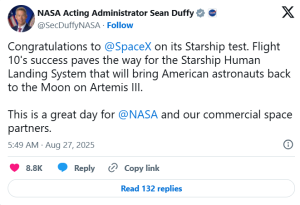
Sean Duffy, who is serving as both the U.S. Secretary of Transportation and the acting administrator of NASA, praised the success of the recent Starship test. He noted that the flight outcome strengthens NASA’s long-term objectives, especially since the agency has a $2.9 billion agreement with SpaceX to adapt Starship for the Artemis program. Under this plan, the rocket is expected to land astronauts on the Moon by 2027.
However, significant technological challenges remain, such as accomplishing in-orbit refueling with supercooled propellant and building a multi-use heat shield capable of withstanding numerous incursions. These advancements are critical not only for NASA’s lunar aspirations but also for Elon Musk’s overarching aim of delivering Starship to Mars. If successful, NASA and SpaceX’s alliance might usher in a new era of deep space exploration, combining government vision with commercial ingenuity.
SpaceX’s 10th Starship flight marks a turning point in modern spaceflight. Through satellite launches, reusability tests, and reentry data collection, the mission showcases progress and potential. Despite challenges, government support and SpaceX’s ambition make deep space exploration and even Mars colonization seem like achievable goals.